

Where the Money Is: Food Trucks
Introduction
Food trucks look simple from the outside. Find a busy spot, serve good food, and watch the line grow. In reality, the business is much more complex.
A food truck owner must manage food costs, labor, fuel, permits, repairs, weather, location, and customer traffic. A long line may look like success, but it does not always mean strong profit. The real money often comes from better locations, higher average orders, repeat customers, catering jobs, and private events.
For sellers and marketers, that matters. A food truck may not need more general awareness. It may need help filling slow weekdays. It could also require promoting a regular location. Booking company lunches might be necessary. Another goal could be turning social media followers into paying customers.
This chapter will help you understand how food trucks make money. You will learn what can hurt their profit. And you will see which questions can uncover the best marketing opportunity.
A Growing but Difficult Business
Food trucks are no longer a small part of the restaurant world. Grand View Research estimates that the U.S. food truck services market reached about $2.01 billion in 2025. The company expects continued growth as customers look for convenient, affordable, and different meal choices.
Growth does not make the business easy. A food truck combines two difficult operations: food service and transportation. The owner must prepare food. They have to move the truck. Additionally, they need to find a legal place to operate. The owner must also attract customers and serve each order quickly.
Then the owner must do it all again at the next stop.
For sellers, the lesson is simple: Do not sell food trucks more exposure immediately. First, find out where that exposure can produce profitable sales.
How Food Trucks Make Money
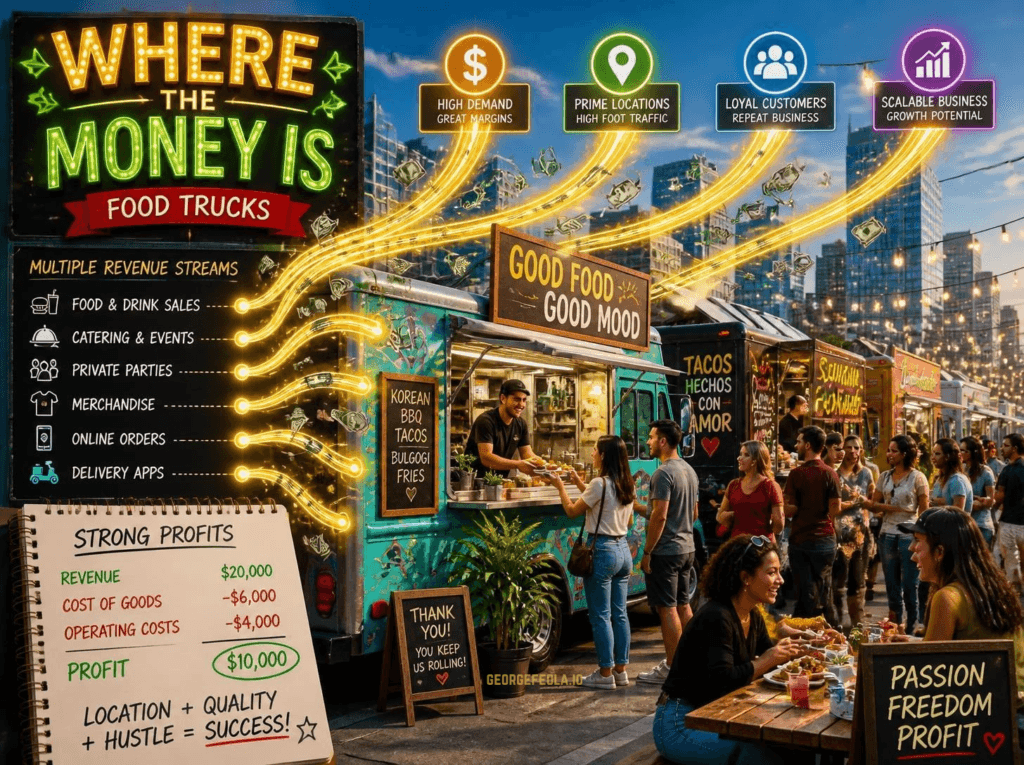
The most visible income comes from walk-up orders. A truck may serve lunch near offices, dinner outside a brewery, or customers at a festival.
Walk-up sales, however, are only one part of the business. Food trucks can also earn money from:
- Company lunches
- Weddings and private parties
- Festivals and community events
- School and sports events
- Catering trays
- Advance orders
- Delivery
- Branded business partnerships
A busy public stop can produce strong sales. A booked event may be better because the truck has a guaranteed payment or a known number of guests.
That certainty has value. The truck is no longer driving around hoping to find a crowd. The crowd is already waiting for the truck.
Where the Best Food Truck Money Is
The busiest-looking stop is not always the most profitable one.
A festival may draw thousands of people. However, the truck may face a large vendor fee. There might be extra labor, long hours, food waste, and several competitors. A smaller company lunch may provide a guaranteed number of orders with less risk.
The strongest opportunities often have three things in common:
- The owner knows how many people may buy.
- The menu can be served quickly.
- The average order produces enough gross profit.
This is why catering, private events, company lunches, and dependable weekly locations can be so valuable. They give the owner a better idea of demand before the truck leaves the kitchen.
Ask which locations create the most sales. Then ask which ones leave the most money after all costs. Those answers may be very different.
The Menu Controls the Money
A large menu may attract attention, but it can also slow service and increase waste.
Each added item may require more ingredients, storage, equipment, and preparation. That is a major issue inside a small mobile kitchen. If an ingredient is only used in one dish, the owner may also lose money when it goes bad.
The best food truck menus are often focused. They use many of the same ingredients across several dishes. They are easy to explain, quick to prepare, and simple for the customer to order.
Drinks, side dishes, desserts, premium toppings, and meal combinations can also raise the average ticket. That matters because every truck has a limit on how many customers it can serve in an hour.
When the grill, fryer, staff, or service window reaches capacity, attracting a larger crowd may only create longer waits. At that point, increasing the value of each order can be more useful than adding more people to the line.

Typical Food Truck Profit Margin
Food truck margins vary widely based on the menu, staffing model, location, operating schedule, and debt on the truck.
Typical profit margin: About 6% to 9% for staffed food trucks. Some strong owner-operated businesses reach higher levels. This depends on sales volume, menu pricing, food costs, labor, event fees, fuel, waste, maintenance, and operating controls. Source: Food Truck Lease Profitability Guide.
Treat that as a working range, not a promise. Private food truck businesses do not report their financial results in one standard way. Owner compensation may be included differently from one estimate to another.
A truck can appear busy and still earn very little. From every dollar collected, the owner may need to cover food, payroll, and card fees. They also need to cover fuel, propane, permits, and insurance. Additionally, commissary rent, event charges, repairs, and taxes are necessary expenses.
The right discovery question is not just, “How much did you sell?”
It is: “Which types of sales leave the most money behind?”
What Eats the Profit
Food is only one expense.
Labor rises when a large event requires added help. Fuel and propane costs change. A repair can take the truck off the road during a strong sales period. Bad weather can ruin an outdoor stop before the first order is served.
Some venues charge a flat fee. Others take a share of sales. Health rules may require the truck to use an approved commercial kitchen or commissary.
The truck itself is also a major investment. Square estimates that a food truck can cost from about $40,000 to $150,000. The cost varies depending on its age, condition, equipment, design, and local requirements.
A weak stop can waste food, fuel, labor, and time at the same time. This is why owners care about dependable traffic. They prefer it over empty impressions. Social media activity that does not lead to sales is not their focus.
Location Is Part of the Product
A restaurant stays in one place. A food truck may move several times during the week.
That mobility can be a strength. The owner can serve office workers at lunch, families in the evening, and large crowds at weekend events.
It can also create confusion.
Customers may love the food but have no idea where the truck will be tomorrow. A social post made 30 minutes before lunch may not reach enough people in time. A schedule buried on a website does not help a hungry customer who is searching right now.
Food truck marketing should make three things clear:
- Where the truck will be
- When it will be open
- What customers can order
The goal is to remove uncertainty. Finding the truck should feel easy.
Repeat Food Truck Customers Create Stability
A first visit creates a sale. A repeat customer helps build a business.
Regular customers are more likely to follow the truck to another location. They may place an advance order. They might bring friends and recommend the truck for an event. Email, text messages, social media, loyalty offers, and retargeting can all support that relationship.
The goal is not to collect followers for the sake of collecting followers. The goal is to turn past customers into future sales.
This fits a larger change in how people buy restaurant meals. The National Restaurant Association’s 2025 off-premises dining research found several factors. Convenience, speed, value, loyalty programs, and special offers help drive takeout. They also influence other off-premises dining choices.
Food trucks fit that behavior well. They serve meals quickly and can meet customers where they already gather. But customers still need a clear reason to visit and an easy way to find the truck.
Buying Signals Sellers Should Hear
Food truck owners often reveal the real problem without calling it a marketing problem.
Listen for comments like:
- “Weekends are good, but weekdays are slow.”
- “People never know where we are.”
- “We need more catering jobs.”
- “We have many followers, but they do not show up.”
- “Lunch is busy, but the average order is too low.”
- “We need more business and brewery locations.”
- “People love us once they try us.”
- “We lose customers when the line gets too long.”
- “Winter is difficult.”
- “That event was packed, but we did not make much money.”
Each statement points to a different need.
A truck seeking catering leads needs a different campaign from one trying to increase lunch traffic. A truck with long lines may not need more customers. It may need advance ordering, a simpler menu, or marketing aimed at slower periods.
Discovery Questions That Find the Money
Use these questions to guide the conversation:
Money: Which menu items, locations, and events produce the most profit?
Customer: Who is your best customer: workers, families, tourists, event guests, or catering clients?
Capacity: How many orders can you serve in an hour without creating long waits?
Seasonality: Which months, days, and meal periods are strongest and weakest?
Conversion: How many people who visit your website or social pages become paying customers?
Ticket: What is your average order, and which add-ons increase it?
Retention: How often does a first-time customer return?
Competitive: What makes your food and experience different from other trucks or restaurants?
Proof: Which reviews, photos, awards, or customer stories build trust?
Measurement: Can you track catering inquiries, online orders, coupon codes, location sales, and repeat visits?
These questions move the discussion away from impressions and clicks. They bring it back to capacity, revenue, and profit.
A Practical Marketing Plan
Good: Help Customers Find the Truck
Keep Google information current. Publish a clear weekly schedule. Use local search, maps, social posts, and location-based advertising.
This works best for a truck that already has some demand but struggles to turn interest into visits.
Better: Build Regular Traffic
Add radio, streaming audio, social video, and retargeting. Promote dependable weekly stops that customers can remember.
The message should repeat the food, location, day, and time. Do not make the customer solve a puzzle.
Best: Grow Catering and Private Events
Use radio or television to build broad trust. Add search, targeted video, social media, retargeting, and a clear catering page.
Show the truck serving real company lunches, weddings, festivals, and private parties. The call to action should invite the customer to check availability, request a quote, or reserve a date.
The campaign is not only selling food. It is selling a fun event and one less problem for the organizer to handle.
The Seller Takeaway
Food trucks do not simply need more people standing near the service window.
They need the right customers at the right locations, with enough demand to make each stop worthwhile. They also need profitable menu choices, larger tickets, repeat customers, advance orders, and booked events.
Before recommending a campaign, find out where the truck makes the most money and where it loses the most time.
Then build the marketing plan around that gap.
That is where the money is.
Subscribe for marketing and tech tips